Thursday, November 18, 2010

The Four Cardinal Virtues Homework (OTHELLO)


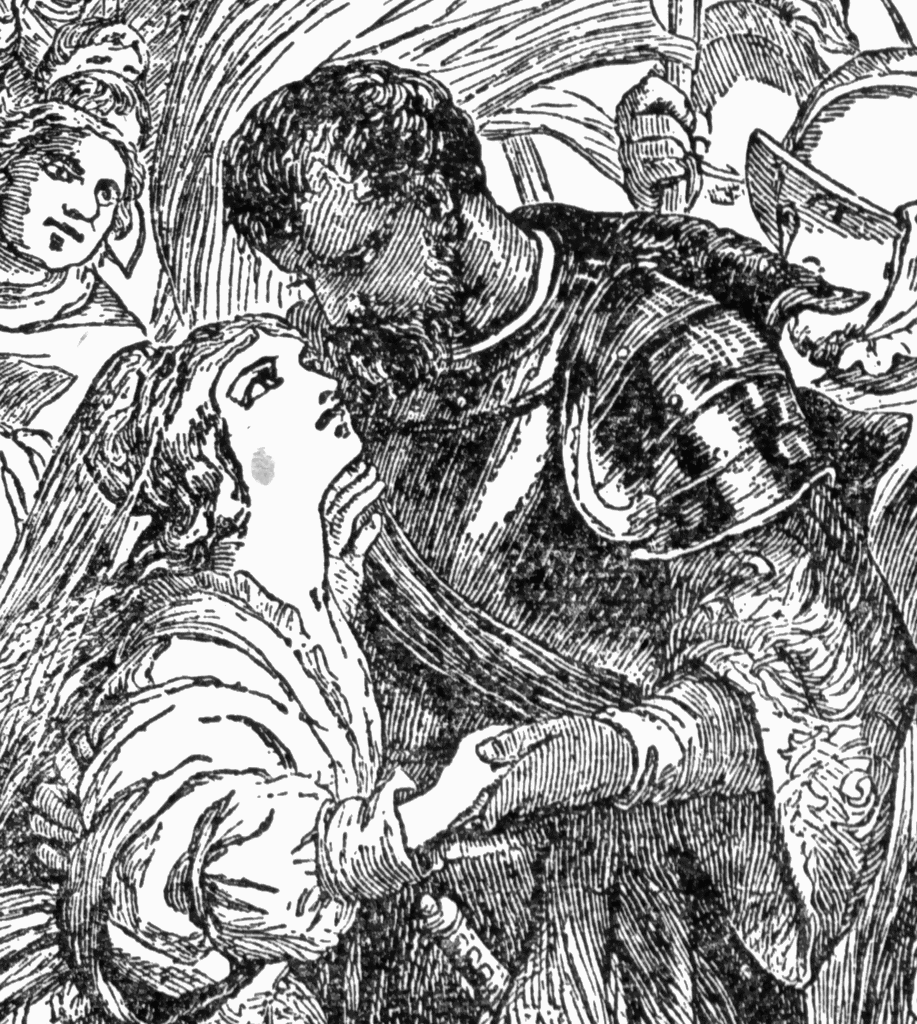
List the female characters and why the roles they play and state if a character is conventional or unconvertional and why? Cite examples from the text. Use the four Cardinals and also aply it to each charater stating why you think possess these virtues. Please get images to represent each female characterand cite your sources.


1. Piety: believed to be more religious and spiritual than man

2. Purity: pure in heart, mind, and body.

3. Submission: held in "perpetual childhood" where man dictated all actions and decisions.

4. Domesticity: a division between work and home, encourged by the industrial Revolution; men went out in the world to earn a living, home became the womens's domain where a wife created a "haven in a heartless world" for her husband and children.


Female Character in Othello


Desdemona:

A Venetian Lady (Unconventional)

Desdemona was uncoventional because she married a man outside of her religion. She married a Moor, who was a Africian American. Also, she talked back to her husband with a room full of men. She didn't listen to what Othello would tell her to do, instead she did her own thingh; Such as taking Cassio's side. When Othello and Desdemona were arguing Desdemona was defending Cassio instead of not listening to Othello.


  • Piety: Desdemona was not more religious than other men because she married a Moor who was not her religion.

  • Purity: Desdemona was pure, because she only stayed with only one man through out Othello.

  • Submission: Desdemona was not submission. She did not deciate all actions that her husband Othello told her.

  • Domesticity: Desdemona was domestic. She stayed home while her husband Othello went to work which was going to wars. He was the general on the army.

Emilia:

Iago's Wife and Desdemona's attendent (Unconventional)

Emilia is unconventional because after stealing Desdemona's handkerchief Emilia feels like she did the wrong thing because Desdemona loved that handkerchief. it was the first gift she got from Othello.


  • Piety: Emilia did believe to be more religious than man in Othello.

  • Pure: Emilia was not ppure in heart mind and body because after she stole the hand kerchief she had the guilty feeling of stealing the handkerchief from Desdmona.

  • Submission: Emilia was submission because she only did what her husband iago told her to do.

  • Domesticity:Emilia is not Domestic. She is not Domestic because she is known as Desdemona's attendent in Othello. Yes, we can all agree on that she stays home but, she work as well while being home.


Binica:

A women in Cyprus in love with Cassio (Conventional)

Binica is conventional because she is proud of what she is. She doesnt complain about how she doesn't like being who she is. Such as, Binica is known as a whore in Othello and she is pround of it.


  • Piety: Even though there were two scence with Binica in Othello, i believe that she is more religious and spirt than the man in the book.

  • Purity: She is pure because she like being who she is, she has so compalins about how she is.

  • Submission: In this case Binica is in love with Cassio. So, she listens to Cassio as he says.

  • Domesticity: Since she was not married Binica was not domestic. She didn't have a husband to work for her and she herself was not at home at all times.

Wednesday, November 3, 2010

Who were the Moors?

1. Who were the Moors?
The Moors were Africans in Africa. They have ruled Portugal and Span for 780 years before slavery time. They had taught Europeans to navigate, trade, and build boats. Later in the years the Spanish and the Portuguese turned on them and used their skills to slave Africa.

2. Who were the Venetians?
Venetians comes from the Italians that moved down from Venice. The Venetian were very wealthy people during the late 1500's and were very famous for there trade and canals.

3. How were the Moors/ Venetians regarded in Shakespeare's day?

Most Christians in Europe regarded Venetians as dishonest people who would happily trade with Muslims and heretics if it were profitable. Moors were Muslims and were therefore generally not liked by most Christians.


4. What was the military duties of ranked officers?
There were different kinds of military duties of ranked officers. There was the General, Lieutenant and, Marshall. The general was the senior army officer. He commands the army opertations in the field but can't pick troops to fight. A Lieutentant is a position that is assigned by the general. Each Lieutentant is in charge ofleast 50 officers. They can give orders to other soliders that have a lower rank than them. Lastly, there is the Marshall. The name is given to a certain civil and military offices of varying rank.

5. What was the military hierachy?
Military hierachy was basically soliders getting paid according to how many victories they win through out there wars. When they became citizen of the country it was the men's duty to serve in the military and protect their country.

6. What was the role of womens?
A womens job druing shakespears time was to be an housewive. The womens did not get any enducation as well.

7. What was expected of a daughter?
For the daughters they had to follow as thier father says. They had to listen to thier father about where were to get married at or who they were to get married to.

8. What was exoected of a bride?
For a bride, the bride had to be loyal and respectful to her husband. She was not sppouse to get married to the one she loved. During Shakespere time they were to love the one who they are married to. When they are married she becomes in charge of the house and majority of things in the house.

9. What rules existed during the time of the play?
During the play rules that existed were: The daughter couldn't marry her choice or the once she loved.

10.What were the rules of courship?
When two people were married they had to think about their future, They would succeed from their love. If the parents die the eldest son would receive most of their wealth and the youngest would recieve the least amount of thier wealth.

Tuesday, November 2, 2010

Shakespeare's othello Blog


1. What rules dictate the behavior of men and women in relationships today?
1a. Rules that dictate the behavior of men and women in relationships today is Honesty and being trustworthy.
2. Name a situation in which rules have been clearly violated? That is what are the things "nice girls" or"nice boys" just don't do?
2a. A situation in which these rules have been clearly violated is when a girl or a boy are not honest to there partern or the other person can't trust there patern. For example if the girl is going to a party or a club the guy would keep calling her to ask her who she is with or check on her what she is up to.

3. Why do these rules exist? Do you think they apply locally or even just at your school? What are the possible consequences of breaking these rules?
3a. These rules exist because all the people today want a long lasting relationship and want a person who can trust them and be honest to them about everything that goes on with them. These rules apply not only in relationship but anywhere you go. No matter where you are or what you do, you need honesty and trust. The consequences of breaking these rules can be, the couple break up and dont last for long or in other things if you not honest you can loose a lot such as good grades go down and the way everyone sees you will change for others if these rules are not followed.

4. Do you know if these rules are applicable to other cultures or are they totally different?
4a. Yes, these rules are applicable to other cultures because everyone is a different culture and all the people want honesty and truth in there lives.

5. Think of scenes from any show/movie that adheres to these rules as well as show/movies that violates these rules.
5a. Singh is King; in this movie the both couple go there own way to work in different countries and trust each other because if they didnt have trust in them they wouldnt have lasted together.
Avtar: in avtar the girl trusted the boy so much but he turned out to be from another world instead of there world, so the girl lost trust in him and left him.